
This is the first time in the RBI's history that a governor is leaving without willing to renew his contract

The poll of over 30 economists, taken in the past week, showed Asia's third largest economy will expand 7.8 percent in the fiscal year ending March 2017.
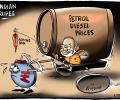
Retail inflation inches up to 3.77%; IIP growth dips to 3-month low

The finance minister chided the central bank on Tuesday over its focus on fighting inflation, saying the Reserve Bank of India (RBI) also needed to abide by the government policy to promote economic growth.
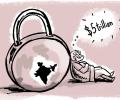
The wait for India to become a $5-trillion economic powerhouse by 2024-25 (FY25) is going to take longer than what the finance ministry had originally intended, according to the International Monetary Fund (IMF). The vision will instead be achieved in 2028-29 (FY29), reveals the IMF data, illustrating a four-year delay. Chief Economic Advisor (CEA) V Anantha Nageswaran had in February said India would become a $5-trillion economy by 2025-26 or the following year, on the back of 8-9 per cent sustained growth rate in real gross domestic product (GDP). However, the IMF data conveys that the economy will be $4.92 trillion in FY28, clearly alluding to the fact that the target will be realised in FY29.
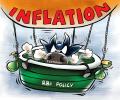
'Election years tend to see high government expenditure on unproductive schemes, though that money sloshing around can boost private consumption.' 'Again, it can mean higher inflation,' explains Devangshu Datta.

The public sector banks are not in a position to cut rates because of their weak balance sheets and massive portfolios of non-performing assets, says Devangshu Datta.

Banks might not have realised the exact implication of risky projects under PPP projects, which were getting implemented under high leverage

The broad market depicted strength. 1,525 shares rose and 1,131 shares fell. A total of 156 shares remained unchanged

The bond market expects at least 25 basis points cut in the June 6 policy.

For the first time, the value of card and mobile payments of Rs 10.57 trillion was more than ATM withdrawals of Rs 9.12 trillion in Q4 of fiscal 2019-20. In the months of lockdown, the gap may have widened further, but cash could be back in vogue when the situation normalises.

The use of RBI capital to strengthen public sector banks will have many positive implications for the economy -- and a few manageable downsides, points out R Jagannathan.

"The poor will not suffer disproportionately due to bouts of sharp inflation, and the middle class will not see its savings eroded," Raghuram Rajan said.

Other members of the high-level advisory committee are former RBI Deputy Governor Usha Thorat, former Securities and Exchange Board of India Chairman C B Bhave, and Nachiket M Mor, Director of the Central Board of Directors of RBI, Governor Raghuram Rajan said.

Two members recommended bringing down the rate by 50 bps in the April policy.

Rajan strongly defends RBI's decision to hold the key rates in the absence of any new data points.

Prices of food articles contracted by 3.47 per cent in June on a yearly basis. Vegetable inflation stood at (-)21.16 per cent.
The finance ministry has ruled out the proposal for the appointment of a chief operating officer (COO) of the rank of deputy governor in the Reserve Bank of India (RBI), as the government feels no interim arrangements should be made for such high-profile appointments.
As a result, the forecast of eight per cent retail inflation by January next year looks achievable.
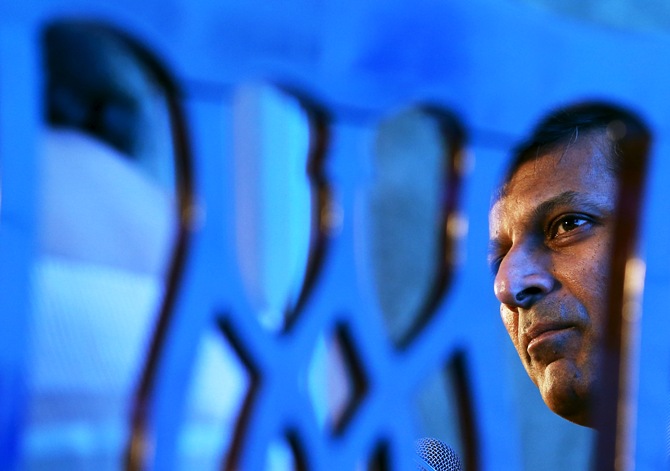
The RBI Governor brought down retail inflation to 3.8% in July.

Duvvuri Subbarao recounts how his tensions with P Chidambaram and Pranab Mukherjee, then finance ministers, over monetary policy spilled over into other issues in the central bank in this excerpt from Who Moved My Interest Rate?, his memoir of his term as Reserve Bank of India governor.

IMF attributes the slower growth rate to supply-side bottlenecks.

Finance minister Arun Jaitley has delivered a Arun Jaitley delivered a bold, far sighted budget

Raghuram Rajan speaks on the unscheduled rate cut.

RBI lowered economic growth for the current fiscal to 6.9 per cent from the previously projected 7.1 per cent, but saw it bouncing back in a big way to 7.4 per cent in 2017-18.

Chaos in Parliament threw a spanner in the government's efforts to revive the economy and kick-start reforms.

High rates of such schemes deter banks from dropping borrowing rates - and thus lending rates

Home Minister Rajnath Singh said that the decision could cost the government roughly Rs 15,000 crore.

Heavy selling of the US dollar by banks and exporters in the face of renewed capital inflows predominantly kept sentiment highly buoyant

While Raghuram Rajan's departure under these circumstances is a pity, it would be wrong to conclude that the RBI or the economy cannot do without him.

The mismatch between industrialists' demand and account holders is because of inflation, Rajan said.

The difference between what the banks play in the US and India is not that of soccer and football but rugby and football. SVB also has a unique character. But when risks are mispriced, the fallout could be very similar, points out Tamal Bandyopadhyay.

Since last month, the realty (down 23%), auto (down 16%) and finance (down 14%) indices have underperformed the market by falling over 13%, as against 8% decline in the benchmark indices

Invest in liquid funds if you have a horizon of three months, ultra-short-term for six months, and low-duration funds for one year.

'Most importantly, marking a departure from the past, the RBI has made it clear that it is not overtly worried about the level of the local currency,' notes Tamal Bandyopadhyay.

The message to bankers from Raghuram Rajan was clear.

If true then it would be a major disruption in the industry

Finance minister Nirmala Sitharaman on Wednesday exuded confidence that inflation would further decline and the government is on track to meet its budgetary target for deficit and said that there is no fear of stagflation in India. Replying to the debate on first batch of Supplementary Demands for Grants 2022-23 in Lok Sabha, the finance minister said inflation has come down and it is now in the tolerable band of the RBI. Inflation has been declining since April 2022 and it is declining further, she said.

Suggesting steps to boost the Indian economy, the IMF chief further said the government should focus on fiscal consolidation.

Rupee, bonds may see knee-jerk reaction, as Urjit Patel is considered an inflation warrior
